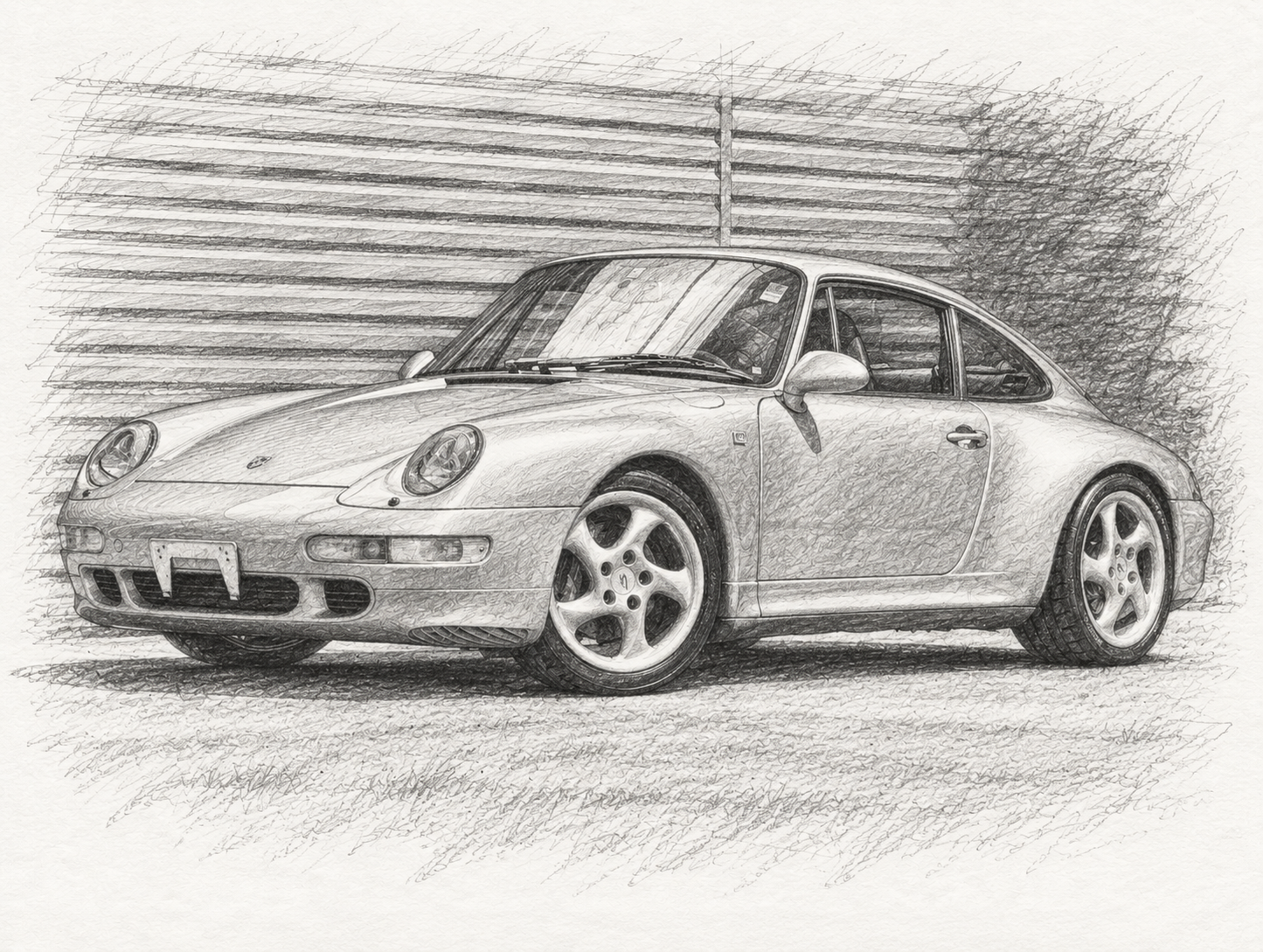
A 993 can make a very convincing first impression. The stance, the glass, the curve of the rear wings: a good photograph makes the decision feel almost finished. The useful work begins when you can explain why this particular car belongs in your garage.
Our starting point is simple: choose the experience you want, establish what the car actually is, and put a cost against the work it needs. This guide concentrates on the naturally aspirated Carrera family. Turbo, RS and GT2 cars deserve their own inspection and valuation brief.
1. Choose the version around your driving.
The 993 replaced the 964 for model year 1994 and closed the production air-cooled 911 chapter in 1998. Its multi-link rear suspension and available six-speed manual helped move the familiar rear-engined layout forward. That history explains the attraction; it does not establish the condition of an individual example. Porsche’s generation history.
- Carrera: the rear-wheel-drive starting point, commonly called a C2. Decide whether you want a Coupé or Cabriolet before comparing prices.
- Carrera 4: adds all-wheel drive. Include the additional drivetrain components in the inspection.
- Carrera S and 4S: both have the wider Turbo-style body. The S is rear-wheel drive; the 4S is all-wheel drive. Similar silhouettes do not make them the same specification.
- Targa: its electrically sliding glass roof gives it a different character from the Coupé and Cabriolet. Roof operation belongs on the inspection brief.
Confirm the exact model, market and original equipment against the car’s documents. Porsche’s Classic model reference explains the body variations; its all-wheel-drive history explains the Carrera 4 system.
Our preference for a first search: start with the body and transmission you genuinely want to use. A wider body or unusual option is worth pursuing if it matters to you, but leave room in the budget for the condition you want to own.
Early or later, manual or Tiptronic?
Model year 1996 brought VarioRam variable intake to the regular 3.6-litre Carrera engine. The manual has six speeds; Tiptronic is a four-speed automatic, with steering-wheel controls on Tiptronic S. Availability depends on variant and market. Use the build specification rather than registration date to identify the car. Porsche’s engine and transmission history; Porsche’s documented Carrera S Tiptronic specification.
Drive the transmission you are considering. If the car has been converted to manual, ask for its original specification, the parts list and the workshop’s record of the conversion. Record factory configuration and present configuration separately.
2. Build a history you can follow.
Before travelling, request the VIN, the current odometer reading and its unit, photographs of the identification and option labels, and readable maintenance invoices. Ask the seller to identify gaps rather than simply describe the file as complete.
Arrange the records by date. Next to each, note mileage, the workshop and what was done. Look for the connection between an advisory and its eventual repair. An invoice recommending work is different from an invoice completing it. Service stamps are useful, but invoices explain the scope. SVP’s workshop buying guidance.
For an imported car, keep the original mileage units alongside any conversion. A change of instrument cluster needs an explanation and supporting records. A vehicle-history report can add another source, but ask the inspector to assess the car itself.
Some especially useful questions are: when was it last driven regularly; why was it stored; what work returned it to use; and which faults remain unresolved? A low odometer reading should prompt these questions just as readily as a high one.
Special colours and special claims.
For a Vesuvio-painted car, a claimed factory power upgrade or a supposed limited edition, ask for documents supporting the exact claim. Establish the original paint, interior and engine specification separately from what is fitted today. A badge or a desirable colour is a reason to investigate, not evidence of a numbered series. Porsche Classic provides period colour documents through its 993 reference collection.
3. Give the body a proper inspection.
A galvanised shell still needs a corrosion check. Ask the specialist to examine the windscreen surrounds, areas beneath the headlamps, bumper supports and rear structural sections, with access agreed in advance. Paint bubbles may show only part of the problem; photographs of a shiny underside do not establish what sits behind covers. Revolution Porsche’s inspection guidance.
Listen when the doors open. A clicking check strap may involve damage to its mounting area, so establish the actual repair before assuming that replacing a strap will settle it. Inspect repaired areas for structure, alignment and workmanship as well as finish. R&D Automotive’s workshop checklist.
For any repaint or accident repair, ask for the reason, dated photographs and invoices. A documented repair can be assessed. An unexplained discrepancy remains an open question. If the inspector cannot see a suspect area, have that limitation written into the report.
4. Separate engine symptoms from a diagnosis.
Arrange a genuinely cold start, followed by a road test and a warm inspection. Ask the seller how much oil is added over a measured distance. Give those figures to the workshop rather than treating a general statement that these engines use oil as an answer.
The inspection should locate oil leaks, examine accessible oil lines and distinguish an external leak from oil being burned inside the engine. Oil reaching hot exhaust components can create smoke and a burning smell. Oil-level checks need the correct warm-engine procedure; ask the specialist to demonstrate it. Revolution Porsche on oil leaks and checking.
Have the ignition history reviewed, including both rows of spark plugs, the twin-distributor belt and the auxiliary belts. Ask what was actually replaced and when. A recent general service does not tell you whether every one of those items was addressed. SVP’s ignition and belt checks.
Secondary-air faults need their own investigation.
On cars equipped with secondary-air injection, restricted passages can generate emissions-system problems. Have the workshop identify the fault and its cause before accepting either a promise of a simple clean or a recommendation for a top-end rebuild. Bodymotion’s published workshop account describes both successful cleaning and cases involving substantial deposits and oil consumption. Those experiences support diagnosis of the individual engine, not a universal repair at a particular mileage. Bodymotion’s technical account, archived on Rennlist.
Ask for a diagnostic report appropriate to the car’s model year and market, and an explanation of any incomplete emissions checks. Confirm that unresolved faults can be dealt with where you intend to register and use the car.
Check the wiring history, too.
Ask Porsche to check the VIN for applicable campaigns and recorded completion, including the W301 engine-wiring campaign affecting certain early 993s. Have the present wiring inspected even when paperwork records previous work. Callas Rennsport’s technical explanation.
For US cars, an empty online recall result is not a complete historical clearance: NHTSA says its VIN results may omit recalls over 15 years old, completed recalls and manufacturer service campaigns. NHTSA’s search limitations.
A little more clarity
Common questions
Does a PPI normally include compression and leak-down testing?
Do not assume so. Ask the workshop to specify what is included, why extra tests may be useful, what access is required and what the additional cost would be.
Does low mileage tell me the car needs less work?
Treat mileage as one part of the history. Ask about storage, regular use, recommissioning and outstanding work, then relate the records to an independent inspection.
What should I ask when a seller says the engine was rebuilt?
Request the itemised invoice, date and mileage, the workshop details and the reason for the work. Establish which components were checked, repaired or replaced and review the evidence with your inspector.
Should I dismiss a car with a documented repaint?
Ask why the paintwork was done and have the underlying repair and structure inspected. Decide whether the documented history and current condition fit your ownership plans.
Is this guide a valuation or an inspection of the pictured Porsche?
No. It is a researched buying guide for the Carrera family. The supplied photograph and sketch are model references; the particular car you consider needs its own records and inspection.
5. Ask for compression and leak-down explicitly.
A PPI quotation may cover a visual inspection and road test without either of these tests. Discuss them when booking, including the additional cost, access and seller’s permission. For a serious 993 candidate, they are worth considering as evidence about cylinder sealing, particularly when engine history or symptoms leave questions open.
Compression testing measures the pressure each cylinder builds while the engine cranks. Request all six readings, with units and test conditions. Compare them with the applicable specification and with each other. A low figure needs interpretation; it does not identify a failed component on its own. OTC compression-tester instructions.
Leak-down testing applies controlled air pressure to a stationary cylinder with its valves closed. The amount and location of leakage help direct further investigation. Air heard at the intake, exhaust or crankcase suggests different paths to examine. Ask for the results for every cylinder, equipment and test pressure, warm or cold condition, and the inspector’s explanation. OTC cylinder-leakage instructions.
These are cylinder-sealing tests. They do not directly measure valve-guide clearance or establish the condition of the entire engine. Keep oil-use history, observations and further diagnostic work alongside the numbers. Avoid a universal pass percentage or a rebuild decision based on one unexplained reading.
Read our separate guide to what the two tests can—and cannot—tell you.
6. Make the road test earn its place.
Use a route the seller and inspector agree is suitable, and assess the car within normal road speeds. Write down observations while they are fresh. “Drives well” is much less useful than a description of when a symptom appears.
- Transmission: note clutch take-up and gear selection from cold and when warm. With Tiptronic, check engagement and changes in its available operating modes. Report hesitation, harshness or noises to the specialist.
- Chassis: note wandering, knocking and uneven ride behaviour. Ask the workshop to relate these observations to tyres, alignment and inspected suspension components.
- Brakes: have the inspector assess operation and inspect the discs, pads, pipes and calipers. Include surfaces that are difficult to see through the wheels.
- Cabin: operate the seats, windows, gauges, locks, heating and air conditioning. Ask for a diagnosis before accepting a claim that an inoperative system only needs a minor adjustment.
R&D highlights clutch behaviour, the dual-mass flywheel, brake corrosion, suspension and cabin systems in its 993 inspection checklist. Use those areas to brief a specialist, rather than trying to diagnose the car from the driving seat.
For a Targa or Cabriolet, include the entire roof cycle, seals and evidence of water entry. A roof that opens once has not yet had its condition established. SVP specifically flags Targa operation and sealing in its workshop guide.
7. Compare the cost of the car you will own.
Before making an offer, ask for a written estimate split into three parts: work needed before use, work likely to be needed during your first year, and changes you would make purely for preference. Keep uncertain items visible, with the investigation needed to resolve them.
A suspension replacement invoice, for example, should tell you which parts were fitted. An engine rebuild description should come with its scope and supporting paperwork. The headline amount spent by a previous owner does not explain the remaining work.
When comparing listings, hold body style, transmission, driven wheels, market specification and condition as constant as possible. Separate asking prices from completed sales. Then consider mileage history, originality, modifications and documented repairs. This guide offers no live valuation or forecast of future prices.
Write down the asking price, the known work and the unanswered questions. The decision becomes clearer when all three are on the same page.
A brief to send your inspector.
Send the listing and documents before the appointment, followed by these requests:
- Confirm the identity and specification, including any conversion or unusual factory claim.
- Review the history against the observed condition and identify unexplained gaps.
- Inspect structure, corrosion and repairs, recording inaccessible areas.
- Assess the engine from cold and warm, oil leaks and reported oil consumption, ignition, wiring and relevant diagnostics.
- Quote separately for compression and leak-down testing; provide cylinder-by-cylinder findings if carried out.
- Inspect drivetrain, suspension, brakes, tyres, cabin equipment and any opening roof.
- Supply photographs, priorities, repair estimates and the questions that remain unresolved.
Our buying view: pursue the example whose identity, condition and history you can understand—and whose remaining work fits your plans. If the seller cannot support an important claim, or the inspection leaves a material problem unexplained, resolve it before committing. There will be other cars to see.
Planning a useful PPI · Reading a car’s records · Explore the 993 model family
About this guide.
Written for The Analog Stable and researched on 4 October 2026. This is a researched editorial guide, not a report from inspecting the pictured car. The photograph and AI-assisted sketch are supplied reference illustrations; no pictured car is offered for sale.
Research included Elferspot’s 993 Carrera buyer’s guide, Porsche’s own model records, specialist workshop guidance and the technical references linked above. The article’s structure, buying framework and wording were developed independently. Published technical advice has not yet received a separate commissioned specialist review. A car-specific inspection remains essential.