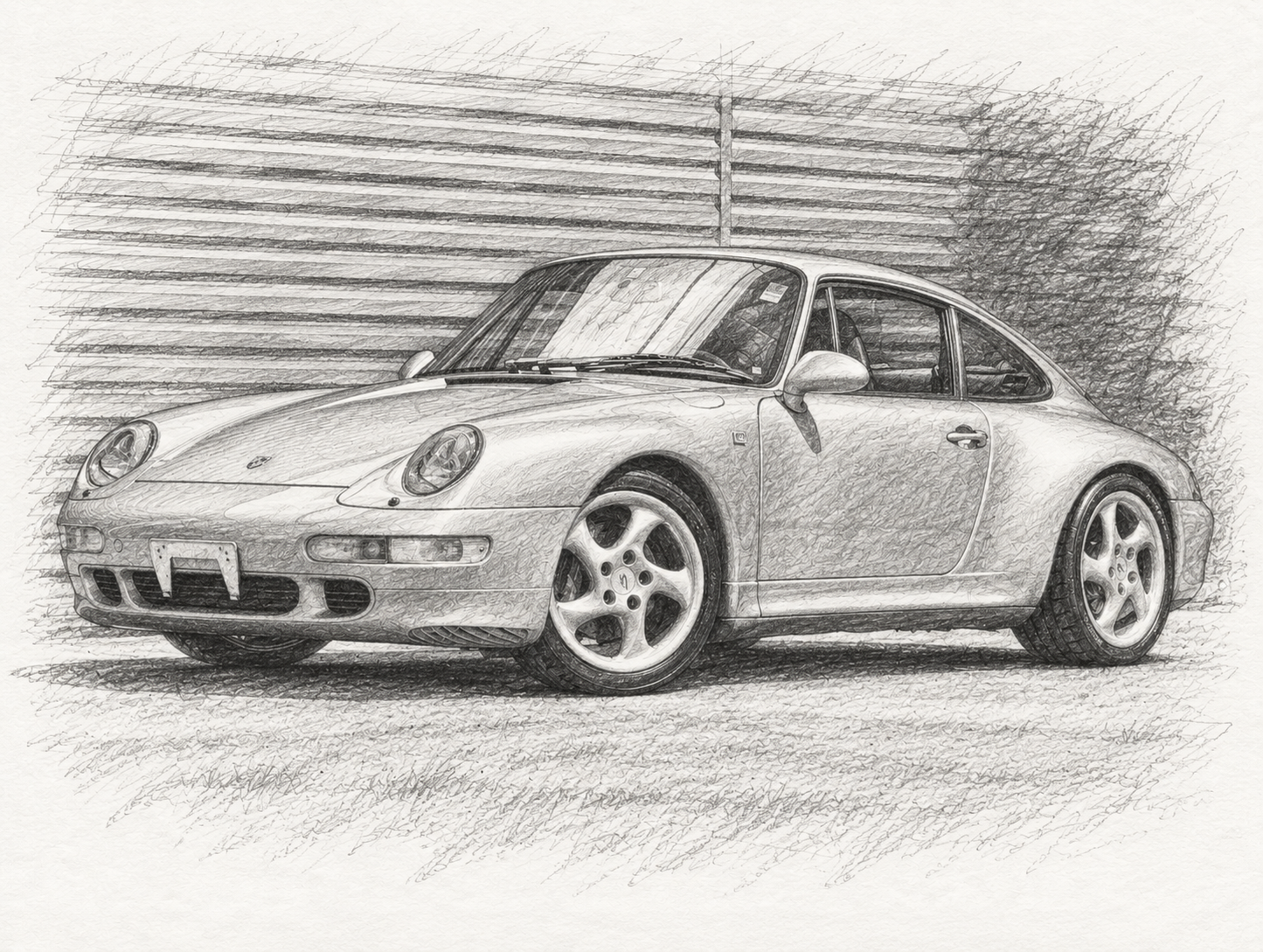
Start with two separate questions
A 993 search becomes easier when body shape and driven wheels are considered separately. Do you prefer the slim outline of the regular Carrera, or the fuller rear quarters of the S models? Then consider whether you want rear-wheel drive or all-wheel drive. Keeping those questions separate stops a badge from doing too much of the decision-making.
Within the regular Carrera family, the Carrera and Carrera 4 use the narrow body. The Carrera S and Carrera 4S share the Turbo-style wide body. The S drives the rear wheels, while the 4S drives all four. Both S models retain a naturally aspirated 3.6-litre flat-six. Porsche’s model history explains the relationship.
Narrow body or wide body?
The terms describe the bodywork, particularly the rear wings. They do not tell you whether the car has a turbocharged engine. On the S and 4S, Porsche combined the Turbo bodyshell and front panel with a retractable Carrera rear spoiler. The Carrera S also has a distinctive divided rear intake grille. Porsche Classic’s model reference records these visual differences.
For a buyer, the useful question is which shape you enjoy looking at and living with. A narrow-body car has its own appeal; it should remain on the shortlist if its specification, history and condition fit your plans. A wide-body car may be the shape you have always wanted. Neither description establishes the quality of the individual example.
The names also need context. This comparison concerns the 993 Carrera family. Do not carry the same assumptions into another 911 generation: Porsche has changed the relationship between badges, body widths and equipment over time.
A little more clarity
Common questions
Is a wide-body 993 always a Turbo?
No. The Carrera S and Carrera 4S have wide bodywork but naturally aspirated engines.
Does the Carrera S have all-wheel drive?
No. The 993 Carrera S is rear-wheel drive. The Carrera 4S is all-wheel drive.
Can I identify Turbo brakes just by their red colour?
No. Calipers can be repainted and brake systems can be modified. Ask the inspecting specialist to identify the parts fitted to the car.
What “Big Reds” means
Porsche’s brake history gives a useful size comparison: standard 993 front discs measure 304 mm, while the Turbo’s measure 322 mm. The larger system is intended to manage greater braking demands. Braking converts motion into heat; disc size, ventilation, calipers, pads and fluid must be considered together. Porsche’s explanation of brake development.
Do not infer stopping distance from caliper colour alone. Tyres, surface conditions and the condition of the complete brake system matter. Nor does repainting a caliper turn it into a Turbo component. On a viewing, have the specialist identify the actual parts and assess their condition.
The Carrera S retained the smaller Carrera-type brake specification in standard form. Its 1997 road test lists 12.0-inch front and 11.8-inch rear discs. A used S may have been upgraded, so distinguish its original configuration from what is fitted today. A documented change is something to understand, rather than a reason by itself to reject the car.
Choosing between them
Our view is that the decision should begin with use and preference, then move to evidence. Put a well-maintained example of each relevant version on your viewing list. During the drive, notice the steering, ride, seating position and how comfortable you feel with the car. Compare them on similar roads where possible, without trying to find their limits.
Write down what matters before seeing prices: wide or narrow body, driven wheels, transmission, roof, colour and intended journeys. Mark which preferences are essential and which are flexible. This gives you a reasoned way to compare two cars whose histories, equipment and asking prices may differ considerably.
Check the individual car
Ask the inspector to establish factory identity from the chassis and supporting records, then record any changes to wheels, brakes, suspension or bodywork. Badges, painted calipers and a divided grille can be changed. A clear inspection should explain what is original, what has been replaced, and what requires attention.
For the wider purchase process, continue to the 993 Carrera buyer’s guide. It covers the history file, body, engine checks and preparation for a specialist inspection. The right specification is only the beginning; the records and condition make it a particular car worth considering.